The spouses’ retaliatory war
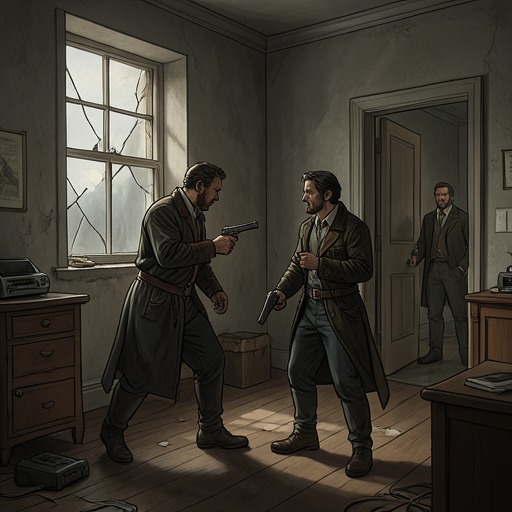
The War of the RosesThe spouses’ retaliatory war is the escalating conflict between Oliver Rose and Barbara Rose after their marriage breaks down. Their struggle over the home becomes a contest of reprisal: damage to food, plants, furnishings, and appliances answers earlier injuries, while each new act makes the house less a shared domestic space than a dangerous arena. The conflict reaches beyond the couple, unsettling their children and placing Ann in the position of confidante and observer.
From separation to open hostility
Barbara’s decision to leave the marriage unsettles a family that had understood its parents’ partnership through the many things they did together. When Eve tells Ann that her mother described the decision as a declaration of independence, she explains that Barbara wanted to pursue her aspirations and no longer be an appendage. Eve struggles to reconcile that choice with the household’s outward image of a close, cooperative family; what troubles her most is the possibility that her mother had not been happy with her father. Ann, who knows more about the situation than Eve does, cannot make the rupture feel any less real.
The separation gradually changes the children’s place in the conflict. At first they try to bring their parents back together, but their efforts fade in the face of persistent hostility. Eve spends more time with friends, while Josh finds steadiness in basketball and other sports and continues to see his father. Later, Eve tells Ann she is afraid to go to camp, not because she misunderstands the situation but because she fears leaving Oliver and Barbara alone together. She asks Ann to keep that fear secret, revealing how the couple’s private struggle has made their daughter a witness and keeper of family anxieties. When Eve and Josh remain away and cannot reach their parents, Eve’s worry rises into tears; Ann promises to find out where they are and urge them to call.
Ann, meanwhile, is both an observer of the Roses’ deteriorating marriage and a person with her own feelings for Oliver. She watches movements, looks, and stray remarks for signs of what might happen, then reviews them in her mind. Her effort to remain detached does not spare her from guilt or anxiety. The children’s changing behavior and Ann’s guarded attention show how the conflict spreads through the household before the retaliation becomes openly physical: the war is between the spouses, but its atmosphere is shared by everyone living under their roof.
Retaliation through food, plants, and the sauna
The first reprisals turn ordinary household work into a means of striking back. After Barbara destroys Oliver’s orchids, he treats the loss as an offense requiring punishment. In her kitchen he finds seven neatly wrapped meat loaves intended for her catering customers. He kneads large quantities of ginger, curry powder, and salt into some, substitutes sugar for salt in another, and reshapes each loaf to fit its wrapping. His pleasure lies not simply in spoiling the food but in imagining Barbara’s customers trying to identify what has ruined its taste. The kitchen, built to support Barbara’s professional ambitions, becomes an instrument Oliver uses against them.
The retaliation also reveals how sharply the spouses’ understanding of the conflict has diverged from ordinary disagreement. Oliver sees the orchids as defenseless victims and tells himself Barbara must be punished; in the sauna, where he mourns them, the satisfaction of his revenge briefly eases his sense of loss. Barbara, for her part, regards the sabotaged catering order as another injury in a struggle that has already exceeded rational negotiation. Each can frame an attack as a response to what the other did first, so that neither act closes the account: each supplies grounds for another.
That logic becomes physically dangerous when Barbara traps Oliver inside the heavy redwood sauna door. After their confrontation, Oliver enters the sauna; Barbara takes a chisel and wooden mallet from his workshop and wedges the chisel into the crack of the door. Her action turns a shared domestic construction into confinement, and Oliver is left inside with the heat and smoke. The episode marks a decisive escalation: the home’s amenities and tools are no longer simply possessions or evidence of the couple’s former cooperation, but resources that can expose the other person to bodily danger.
Once free, Oliver carries his retaliation into Barbara’s sunroom. Still holding the chisel, he cuts the stems of her African violets and Boston ferns, pulls them from their pots, and gathers them on a rug. He then takes the plants to the kitchen, packs them into the largest stock pot, fills it with water, and puts it over a low flame. He recognizes the act as pointless and mad, but says it makes him feel better. The sequence echoes the treatment of his orchids while reversing the target: a wound to one person’s plants becomes a deliberate assault on the other’s. Oliver later tells Murray Goldstein that he had wanted to murder Barbara and nearly did, but turned instead to destroying the plants; in his account, they saved her life.
His admission makes explicit what the acts have been approaching. The couple’s retaliatory war is not merely a dispute over who will keep the house: each attack tests how much harm the other can inflict and endure. Barbara’s confinement of Oliver and his destruction of her plants leave the domestic setting implicated in the violence, while the food sabotage carries the feud beyond the marriage to Barbara’s customers. The distinction between attacking a spouse and attacking what the spouse values has begun to collapse.
Sabotage becomes a household system
The attacks grow more calculated as the Roses turn access and ordinary equipment into covert weapons. Oliver makes a mold of the lock on Barbara’s room and fashions a key from it, then secretly empties her Valium capsules and fills them with Dexedrine. He tells neither Murray Goldstein about the key nor about the drug substitution. In his own accounting, these acts are provocations made necessary by Barbara’s earlier conduct; to an outside observer, he recognizes, they would appear irrational. His insistence that their situation is exceptional helps him treat concealment and escalation as forms of self-defense.
Barbara’s attempt to prepare a dinner party brings the danger into the kitchen she had designed for her catering work. She moves a cot there the night before, checks the food and wine for tampering, and begins preparing a long list of ingredients. Then the cold taps run hot enough to scald her hand, a mixing head flies from its bowl, and the Cuisinart continues slicing after she has switched it off. The stove burners remain red-hot despite her turning their knobs; when she pulls at the machine’s cord, it falls and sends its blade across the kitchen. A knife box tips over and cuts her thighs, the disposal starts, and appliances across the room come alive in a mounting clamor. She falls and reaches the basement floor, then drags herself back upstairs with cuts, bruises, and a scalded hand. Convinced Oliver has booby-trapped the kitchen, she disconnects the compromised appliances with tools from his workshop. Rather than abandon the dinner, she buys a hand-operated meat grinder and manual slicing and grating tools, turning her injuries into a hardened determination to continue.
Barbara’s counterattack targets an object Oliver prizes rather than a person, but the method makes the threat unmistakable. She adjusts the garage-door mechanism’s fail-safe, drawing on Oliver’s earlier explanation of how it had nearly crushed Mercedes, who escaped in time. She releases the emergency brake on Oliver’s Ferrari, shifts it into neutral, and pushes it partway beneath the heavy door. Then she repeatedly lowers the door onto the car, moving the vehicle so the blows can crush different sections. The steering column bends, a wheel breaks off, and the dashboard crumbles. She experiences the destruction as a rush of exhilaration, then pushes the damaged car back into the garage and replaces the remote control on its hook. The familiar apparatus of the home has become a weapon, while a prized possession becomes the target through which one spouse answers the other’s assault.
The house becomes a siege
Barbara Rose’s attack on the library armoire shows how thoroughly the spouses’ shared possessions have become weapons. She had long hated the bulky cabinet, which she associated with masculine excess, and secretly sawed through its front legs where they joined the cabinet and cemented its doors. She expected a heavier crash; when the result fell short, she concluded that she had not applied enough force or commitment. The damage to Oliver Rose’s Ferrari had restored her courage, but now she resolved to make him leave the house, even if the effort killed her. With the children away at camp, she had the empty house to herself and freedom to maneuver, yet the intimacy of their former household remained embedded in every object she turned against him.
At their dining-room confrontation, the dispute over who would leave becomes explicit. Barbara says she can resist indefinitely; Oliver answers that he can resist her resistance just as long. He insists the house is his because he paid for it and says he will find a way to get it even if the courts decide otherwise. Barbara touches the cool blade of her cleaver as she rejects his attempt to intimidate her. Their argument is no longer about how to end the marriage with minimal harm: Oliver casts her wish to leave as destruction of the family, while Barbara cannot understand why he chose to remain and prolong the hostility. The house has become both the object they contest and the ground on which each tries to prove the other cannot force a surrender.
The encounter turns from words to damage when the room goes dark. Barbara hears metal scrape against wood as Oliver’s crowbar bites into the Duncan Phyfe table. The harm to the furniture seems to reach her bodily; she retreats through the hall and upstairs to Josh Rose’s room, then curls up in his closet with her shopping bag and the cleaver clenched in her fist. From this hiding place she hears Oliver’s destructive outburst. The retreat carries the conflict into a child’s private space, making the children’s rooms part of the couple’s improvised battlefield even while Eve Rose and Josh are away.
Oliver answers her concealment with a methodical transformation of the house into a trap. By candlelight, after finding a broken Staffordshire figure named Garibaldi and Barbara’s lipstick warning that she will break another figure every day, he removes the bolts from hinges throughout the house, leaving his own door and the doors to the outside world as exceptions. He arranges doors so the slightest movement will make them fall, then loosens furniture bolts, legs, and supports so the pieces will topple when touched. He avoids the wrecked dining room but sees the insult he carved into the table. In the kitchen, he loosens the screws and bolts holding the remaining overhead pots, shelves, and cabinet doors, leaving each near the point of collapse. The work is deliberate rather than impulsive: room by room, the familiar household is made unreliable, and ordinary movement becomes a potential trigger.
The progression from spoiled food and damaged plants to a trapped sauna, sabotaged appliances, a crushed Ferrari, and a house rigged to fall marks the war’s narrowing moral and physical limits. Each spouse treats the other’s latest act as proof that retaliation is necessary; each new counterattack then removes another safe or neutral part of their shared life. Their children and Ann remain caught in the consequences, while the home that once expressed the couple’s joint identity becomes an apparatus of concealment, injury, and threat.